When it comes to wrestling I’m just a fan. Oh sure, I know the difference between an inside trip and a fireman’s carry – but it’s knowledge gained from watching countless matches at all levels of competition – not actual experience.
Because a few people read this blog every week, and some seem to like it, I occasionally get emails asking to support various wrestling-related causes. I’m also a denizen of several wrestling forums where I will encounter posts asking for some kind of help. (How many of us own tee shirts supporting our favorite Olympic athletes?). Clubs need mats, colleges need money to save programs or to start new ones, the Dan Gable International Wrestling Museum needs money to recover from the flood, etc. All are worthwhile causes.
I may just be a wrestling fan – but I’m a pro at asking for money. Yep, I’ve been a direct marketing consultant for almost 30 years. I’ve sold you or your friends jewelry, shoes, magazines, pizza, air conditioners, router tables, dresses, hotel rooms, etc, etc, etc – all by putting paper in your mailbox. I’ve also raised a lot of money for charities. So, this week I’m not going to talk about wrestling. Instead, I’m going to offer “Fund Raising 101”
A person gives to another person – not organizations or causes.
This is the most fundamental rule of fund raising – and the most ignored. Perhaps the most famous (and one of the most successful) of all fund raising letters is the Frank Deford “65 Roses” letter for the Cystic Fibrosis Foundation. In that letter, Deford tells the story (legend) of how some kids came to call that awful childhood disease, “65 Roses”. He also tells you that his daughter suffers from Cystic Fibrosis and asks you to help him fight the disease.
Save Oregon Wrestling did a reasonably good job of this. Their email efforts are always personal appeals from Coach Ron Finley and do a good job of projecting a “David vs. Goliath” image. The website also makes solid use of individual wrestlers.
This rule applies to all fund raising efforts – not just direct mail. You’ll sell more candy, wash more cars and get more golf swings if you can make the event about an individual instead of the club, team, institution or sport.
Faces
A person will respond to a “face”. As you create your materials be sure that your audience can tie a face to your cause.
Make curing cancer “trivial”.
Passion, passion, passion! Your listener, reader or candy buyer has to believe at the very moment of receiving your message that those new mats for Jimmy and Susie are more important than curing cancer. Most donors make a first gift on impulse.
Al Bevilacqua is a perfect role model. His passion for Beat the Streets jumps off the page or screen at you.
Use the “motivators”. We “evil marketers” know that there are only nine prime motivators that will move a person to spend money:
Greed
Sex
Fear
Guilt
Anger
Exclusivity
Belonging
Salvation
Flattery
The more of these you appeal to, the more successful you will be. Guilt, exclusivity, belonging and flattery work especially well in fund raising. Anger and fear can be powerful, but can also backfire.
Get the second donation.
After years of testing, the great direct mail guru, Dick Benson, found that a 2X donor is twice as likely to respond to all future efforts than is a 1X donor. That makes the second donation crucial. Here’s a pattern that works.
Get the initial donation.
Send a thank you note within a week of the first donation (do not yet ask for the second donation).
Thirty days later ask for the second donation.
Women write more checks – men write bigger checks.
This is not sexism – it’s data. Think about your particular need. If you’re asking for a one time, major donation you might consider strategies that are more appealing to men. If long term support is your goal, create a message that reaches out to women.
Tell them what you need and ask for a specific amount.
One of my most successful campaigns was for a small town youth recreation center that needed new stairs up to the gym. When I saw the construction estimate I realized that each stair was going to cost $370. I simply asked the readers to donate “a half stair, a full stair, or 2 stairs”. We still received several $25 contributions, but the overall average gift was much higher than previous appeals.
We also put a plaque in the stairwell recognizing all of the donors that gave “at least one stair”.
If you need $10,000 for new mats – tell them. If you need $1,000 per wrestler to go to Fargo – tell them. The “every little bit helps” approach is generally ineffective.
Ask more often.
Most organizations simply don’t ask for donations often enough. Why? That’s just like scoring one takedown at the beginning of a match and never taking another shot. Keep asking. Let your donors decide how frequently they’re willing to give – but they won’t give unless you ask.
Once again, I point to Save Oregon Wrestling as a positive example. If you gave to them, you know how frequently they will contact you.
I hope this helps a little. Now – go out there and raise some money.
Monday, September 15, 2008

Monday, September 8, 2008
An endangered species?
“I would have all of my offensive linemen wrestle if I could.”
John Madden
NFL Hall of Fame Coach
Back at Davenport Central High School in the late ‘60s almost all of the wrestlers played football – probably because Jim Fox (in the Iowa High School Athletic Hall of Fame as a football coach, wrestling coach and wrestling official) coached both sports.
That wasn’t all that unusual.
In the ‘70s and ‘80s it was still fairly common for college athletes to compete in both sports. Every Hawkeye fan over the age of 30 remembers Mark Sindlinger, who in December of 1987 started at center for the victorious Holiday Bowl football team and four months later was an NCAA wrestling All-American at heavyweight.
There are dozens of current and past NFL stars who come from a wrestling background. Hall of Fame coach, Joe Gibbs, was once quoted, “I draft wrestlers because they are tough. I have never had a problem with a wrestler.”
Stephen Neal has a phenomenal resume: two-time NCAA heavyweight champion, World Heavyweight Freestyle Champion and 4 Super Bowl rings as a member of the New England Patriots. Neal, however, was not a two-sport athlete in college – choosing to concentrate on wrestling. Carlton Hasselrig, the only 6X NCAA wrestling champion (3 in Division II and 3 in Division I), followed a similar path. He competed only as a wrestler at the University of Pittsburgh-Johnstown but went on to a career with the Steelers and Jets.
Other pro football stars excelled at both sports while in college. Curley Culp is probably the most notable. A 6X Pro Bowl nose tackle, he pinned three of four opponents to win the 1967 NCAA heavyweight title while competing for Arizona State University. He would later be named the Greatest Athlete in the History of Arizona during the state’s centennial celebration.
Pro football players, Rob Essink, Jim Nance and Lorenzo Neal were also NCAA wrestling champions.
Match forfeits have become a major problem in high school wrestling. Somewhat understandably, the 103 and 112 pound weight classes lead in the total number of forfeits. Surprisingly (at least to me), a high percentage of 215 pound matches are also forfeited. Wouldn’t this be a perfect weight class for a lot of high school football players? Why are teams finding it difficult to fill their rosters at this weight? Stephen Neal has said, “Wrestling develops skills that translate to football: leverage, balance, explosion and hand fighting?” Are young athletes specializing too early? Are they missing out on the values of wrestling because of a misguided belief that specialization is the key to success?
Has the day of the multi-sport coach gone by the wayside? If so, is this also reducing the numbers of multi-sport athletes?
Lots of questions. I wish I had some answers.
John Madden
NFL Hall of Fame Coach
Back at Davenport Central High School in the late ‘60s almost all of the wrestlers played football – probably because Jim Fox (in the Iowa High School Athletic Hall of Fame as a football coach, wrestling coach and wrestling official) coached both sports.
That wasn’t all that unusual.
In the ‘70s and ‘80s it was still fairly common for college athletes to compete in both sports. Every Hawkeye fan over the age of 30 remembers Mark Sindlinger, who in December of 1987 started at center for the victorious Holiday Bowl football team and four months later was an NCAA wrestling All-American at heavyweight.
There are dozens of current and past NFL stars who come from a wrestling background. Hall of Fame coach, Joe Gibbs, was once quoted, “I draft wrestlers because they are tough. I have never had a problem with a wrestler.”
Stephen Neal has a phenomenal resume: two-time NCAA heavyweight champion, World Heavyweight Freestyle Champion and 4 Super Bowl rings as a member of the New England Patriots. Neal, however, was not a two-sport athlete in college – choosing to concentrate on wrestling. Carlton Hasselrig, the only 6X NCAA wrestling champion (3 in Division II and 3 in Division I), followed a similar path. He competed only as a wrestler at the University of Pittsburgh-Johnstown but went on to a career with the Steelers and Jets.
Other pro football stars excelled at both sports while in college. Curley Culp is probably the most notable. A 6X Pro Bowl nose tackle, he pinned three of four opponents to win the 1967 NCAA heavyweight title while competing for Arizona State University. He would later be named the Greatest Athlete in the History of Arizona during the state’s centennial celebration.
Pro football players, Rob Essink, Jim Nance and Lorenzo Neal were also NCAA wrestling champions.
Match forfeits have become a major problem in high school wrestling. Somewhat understandably, the 103 and 112 pound weight classes lead in the total number of forfeits. Surprisingly (at least to me), a high percentage of 215 pound matches are also forfeited. Wouldn’t this be a perfect weight class for a lot of high school football players? Why are teams finding it difficult to fill their rosters at this weight? Stephen Neal has said, “Wrestling develops skills that translate to football: leverage, balance, explosion and hand fighting?” Are young athletes specializing too early? Are they missing out on the values of wrestling because of a misguided belief that specialization is the key to success?
Has the day of the multi-sport coach gone by the wayside? If so, is this also reducing the numbers of multi-sport athletes?
Lots of questions. I wish I had some answers.
Monday, September 1, 2008
Just what is opportunity?
Olympic champion, Henry Cejudo, appeared on The Tonight Show with Jay Leno Wednesday night. Henry was funny and charming. His story is well-known to the wrestling community – the son of undocumented immigrants, his early life was filled with struggles. Henry and his six siblings were raised by his mother, who worked countless hours to keep her family fed. They moved from Los Angeles to Arizona for better opportunities. Henry and his older brother, Angel, took up wrestling – and became champions (8 state titles between them). Upon hearing about the 8 championships Leno remarked, “I’ll bet nobody ever stole your lunch money.” Henry’s reply was, “We didn’t have any.”
The desire to win Olympic gold burns intensely in Angel and Henry. They took the non-traditional path of going directly from high school to the Olympic Training Center in Colorado Springs. Henry has his gold – Angel still pursues his.
(To view Henry’s appearance go to
http://www.nbc.com/The_Tonight_Show_with_Jay_Leno/video/episodes/
click on August 27 and fast forward to about 32 minutes)
Randi Miller couldn’t make the basketball team at Arlington (TX) Martin High School because the coaches thought she was too short. Fortunately for her, Texas is one of the few states that sanctions girls interscholastic wrestling. Even more fortuitously she had a coach, Tony Warren, who believes, “Wrestling is a sport that no matter what your size is, it comes down to how big your heart is and how hard you’re willing to work. If you’ve got those things you can go a long way.” He saw those things in Randi.
The path for women wrestlers is more challenging than it is for men. First, in all but a handful of states, if a high school girl wants to wrestle she must do so on a boys team. Only one girl in the history of American wrestling has ever won a state championship competing against boys – Michaela Hutchison.
Randi Miller, however, had the opportunity to compete only against girls. She has credited that for her confidence. After graduating from high school Randi went to Neosho County Community College and then on to one of the few American colleges with women’s varsity wrestling, MacMurray College in Jacksonville, IL. She then went to the US Olympic Education Center at Northern Michigan University.
A couple of weeks ago Randi’s journey culminated with a Bronze medal in Beijing.
Nick Ackerman is a bilateral amputee.
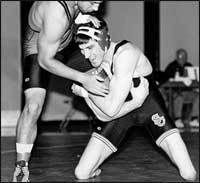
In 2001, I went to Waterloo for the NCAA Division III Wrestling Championships and saw Nick wrestle. In the finals he faced number-one-ranked Nick Slack of Augsburg College who had won his previous 60 matches. To say that the match was exciting is pure understatement. Ackerman won 13-11 and was named Outstanding Wrestler of the championships. Later that year he would join Cael Sanderson as co-winner of the Hodge Trophy – wrestling’s “Heisman”. Recently, his championship was named by the NCAA as one of the 25 “defining moments” of the last 100 years.
Today, Nick works as a prosthetist – helping other amputees.
Anthony Robles was born with one leg.
Undefeated as a high school senior, Anthony now wrestles at Arizona State University. Last season, as a freshman, he finished one match away from All-American status in Division I.
Michael Spriggs is blind. A recent graduate of Charles H Flowers High School in Springdale, MD, Michael has been visually impaired since birth. Born with cataracts, a series of complications and an accident eventually plunged him into total darkness. From the fifth through the tenth grade he lived and studied at the Maryland School for the Blind. He transferred to Flowers his junior year where he met geometry teacher/wrestling coach Odist Felder. An educator in every sense of the word, not only did Felder figure out methods to teach geometry to a blind student he encouraged Michael to join the wrestling team. Michael was 13-12 his first season and made the state tournament this year.
The only rule concession that is given a blind wrestler is that his opponent must always be in physical contact. The wrestlers must touch hands in the neutral position. If contact is broken they must re-start.
Here’s more of Michael’s story from ESPN.
http://sports.espn.go.com/broadband/video/videopage?categoryId=3060647&brand=null&videoId=3394576&n8pe6c=3
Wrestling is the embodiment of the “American Dream”. Hard work, learning, tenacity and resilience are rewarded. Best of all - anyone can win. Race, size, gender, economic status, nationality – none of that matters. Even those with physical challenges can triumph. Now THAT’S opportunity.
The desire to win Olympic gold burns intensely in Angel and Henry. They took the non-traditional path of going directly from high school to the Olympic Training Center in Colorado Springs. Henry has his gold – Angel still pursues his.
(To view Henry’s appearance go to
http://www.nbc.com/The_Tonight_Show_with_Jay_Leno/video/episodes/
click on August 27 and fast forward to about 32 minutes)
Randi Miller couldn’t make the basketball team at Arlington (TX) Martin High School because the coaches thought she was too short. Fortunately for her, Texas is one of the few states that sanctions girls interscholastic wrestling. Even more fortuitously she had a coach, Tony Warren, who believes, “Wrestling is a sport that no matter what your size is, it comes down to how big your heart is and how hard you’re willing to work. If you’ve got those things you can go a long way.” He saw those things in Randi.
The path for women wrestlers is more challenging than it is for men. First, in all but a handful of states, if a high school girl wants to wrestle she must do so on a boys team. Only one girl in the history of American wrestling has ever won a state championship competing against boys – Michaela Hutchison.
Randi Miller, however, had the opportunity to compete only against girls. She has credited that for her confidence. After graduating from high school Randi went to Neosho County Community College and then on to one of the few American colleges with women’s varsity wrestling, MacMurray College in Jacksonville, IL. She then went to the US Olympic Education Center at Northern Michigan University.
A couple of weeks ago Randi’s journey culminated with a Bronze medal in Beijing.
Nick Ackerman is a bilateral amputee.

In 2001, I went to Waterloo for the NCAA Division III Wrestling Championships and saw Nick wrestle. In the finals he faced number-one-ranked Nick Slack of Augsburg College who had won his previous 60 matches. To say that the match was exciting is pure understatement. Ackerman won 13-11 and was named Outstanding Wrestler of the championships. Later that year he would join Cael Sanderson as co-winner of the Hodge Trophy – wrestling’s “Heisman”. Recently, his championship was named by the NCAA as one of the 25 “defining moments” of the last 100 years.
Today, Nick works as a prosthetist – helping other amputees.
Anthony Robles was born with one leg.
Undefeated as a high school senior, Anthony now wrestles at Arizona State University. Last season, as a freshman, he finished one match away from All-American status in Division I.
Michael Spriggs is blind. A recent graduate of Charles H Flowers High School in Springdale, MD, Michael has been visually impaired since birth. Born with cataracts, a series of complications and an accident eventually plunged him into total darkness. From the fifth through the tenth grade he lived and studied at the Maryland School for the Blind. He transferred to Flowers his junior year where he met geometry teacher/wrestling coach Odist Felder. An educator in every sense of the word, not only did Felder figure out methods to teach geometry to a blind student he encouraged Michael to join the wrestling team. Michael was 13-12 his first season and made the state tournament this year.
The only rule concession that is given a blind wrestler is that his opponent must always be in physical contact. The wrestlers must touch hands in the neutral position. If contact is broken they must re-start.
Here’s more of Michael’s story from ESPN.
http://sports.espn.go.com/broadband/video/videopage?categoryId=3060647&brand=null&videoId=3394576&n8pe6c=3
Wrestling is the embodiment of the “American Dream”. Hard work, learning, tenacity and resilience are rewarded. Best of all - anyone can win. Race, size, gender, economic status, nationality – none of that matters. Even those with physical challenges can triumph. Now THAT’S opportunity.
Monday, August 25, 2008
OW! I've blown my toes off.
The Olympics are over. For two weeks we viewed sports we only see every four years and learned the names or stories of great athletes who normally toil in anonymity. Several sports gained new fans and new participants. The best American wrestling could do during the past fortnight was shoot itself in the foot.
The story that got the most media coverage had nothing to do with the Olympics. It was discovered that two University of Nebraska wrestlers had been paid to pose nude for a website that caters to gay men. Neither young man broke the law – nor did they do anything that countless college cheerleaders haven’t done over the years in Playboy “Girls of the Pac Ten” spreads. However, since they did violate the “code of conduct” clauses in their scholarship agreements, Husker wrestling coach, Mark Manning, removed them from the team.
In the end, they did more to hurt themselves than they did to harm the sport. Oh sure, the story probably generated some snickering, but it will pass.
Meanwhile – back in Beijing – Henry Cejudo won a freestyle gold medal at 55 kilos (121.5 lbs). He was a joy to watch. Henry’s story is compelling. The son of undocumented immigrants, Henry’s mother worked multiple jobs keeping food on the table for her family. A four-time high school state champion (two in Arizona and two in Colorado), Henry eschewed the traditional American wrestling career path of continuing to wrestle folkstyle in college before entering the international arena. Instead, he went directly to the Olympic Training Center to concentrate on freestyle. At 21, he became the youngest American to ever win an Olympic freestyle gold.
Surely Cejudo’s success is exempt from my contention that American wrestling “shot itself in the foot”. Wrong. In a post-medal interview, Henry admitted that he had to lose 10 pounds in an hour and a half to “make weight”. When asked how he did it he replied, “Sauna, plastics (suit)…”.
That’s not all. Greco-Roman wrestler, T.C. Danzler, acknowledged that his performance may have been negatively impacted by the amount of weight he had to lose before competing. Finally, Daniel Cormier was hospitalized because his efforts to make weight led to kidney malfunction. Cormier was forced to withdraw from the Olympics.
This is where the toes disappeared.
Youth participation in wrestling has grown steadily, albeit slowly, since the mid ‘90s. That fact is frequently quoted – sometimes when arguing against the elimination of college wrestling programs and sometimes just to put a good face on the sport. What is less frequently mentioned is that high school wrestling lost 150,000 participants between 1977 and 1995. After 13 years of steady climbing, there are still 100,000 fewer high school wrestlers today than in the 1976-77 school year.
Unhealthy weight loss practices contributed to the decline. The perception that these practices still exist at the youth and high school levels are a major roadblock in the efforts to return wrestling to the popularity it once held. It doesn’t really matter that weight loss practices for young athletes are far more stringently monitored now – because the public still perceives “making weight” negatively. Those beliefs could have only been reinforced by the happenings in Beijing.
Even when discussing “marketing” or “promotion” or “growth”, wrestling tends to look inward too much. Many wrestlers and ex-wrestlers read the previous paragraph and thought something like, “Sucking weight is a part of wrestling. If you’ve ever wrestled, you understand that.” Well – I have never wrestled – and neither have most mothers – and they will have a major influence on wrestling’s future. Moms approve, support and – sometimes – determine their kids’ extracurricular activities. Right now, “Mom” thinks wrestling is unhealthy. Our Olympic athletes just told her so.
Wrestling is trying too hard to be an exclusive fraternity. Sons wrestle because their dads wrestled. Big brother wrestles, so little brother does, too. There’s an initiation – complete with hazing and the weight loss ritual. If you don’t “get it” – do something else. Well – that’s not an attitude that will lead to growth.
So what do we do? First, let’s all (wrestlers, coaches and fans) stop talking about weight loss like it is second only to winning a championship in importance. I’ve been just as guilty of this as everyone else – frequently posting my admiration for the way 3X Hawkeye All-American and 1996 NCAA champion, Daryl Weber, cut to 142 to “help the team”.
Second – add a “parent recruiting” element to participation growth plans. Let parents know that there are rules in place to protect the health of their children. More than that – work just as hard to sell parents on the sport as we do the potential participants.
Finally - let’s get more positive images of the sport out into the world. Let’s talk more about Anthony Robles and Dr. Norman Borlaug and Doug Zembiec. And let’s talk about Henry Cejudo’s gold medal – not his weight loss.
The story that got the most media coverage had nothing to do with the Olympics. It was discovered that two University of Nebraska wrestlers had been paid to pose nude for a website that caters to gay men. Neither young man broke the law – nor did they do anything that countless college cheerleaders haven’t done over the years in Playboy “Girls of the Pac Ten” spreads. However, since they did violate the “code of conduct” clauses in their scholarship agreements, Husker wrestling coach, Mark Manning, removed them from the team.
In the end, they did more to hurt themselves than they did to harm the sport. Oh sure, the story probably generated some snickering, but it will pass.
Meanwhile – back in Beijing – Henry Cejudo won a freestyle gold medal at 55 kilos (121.5 lbs). He was a joy to watch. Henry’s story is compelling. The son of undocumented immigrants, Henry’s mother worked multiple jobs keeping food on the table for her family. A four-time high school state champion (two in Arizona and two in Colorado), Henry eschewed the traditional American wrestling career path of continuing to wrestle folkstyle in college before entering the international arena. Instead, he went directly to the Olympic Training Center to concentrate on freestyle. At 21, he became the youngest American to ever win an Olympic freestyle gold.
Surely Cejudo’s success is exempt from my contention that American wrestling “shot itself in the foot”. Wrong. In a post-medal interview, Henry admitted that he had to lose 10 pounds in an hour and a half to “make weight”. When asked how he did it he replied, “Sauna, plastics (suit)…”.
That’s not all. Greco-Roman wrestler, T.C. Danzler, acknowledged that his performance may have been negatively impacted by the amount of weight he had to lose before competing. Finally, Daniel Cormier was hospitalized because his efforts to make weight led to kidney malfunction. Cormier was forced to withdraw from the Olympics.
This is where the toes disappeared.
Youth participation in wrestling has grown steadily, albeit slowly, since the mid ‘90s. That fact is frequently quoted – sometimes when arguing against the elimination of college wrestling programs and sometimes just to put a good face on the sport. What is less frequently mentioned is that high school wrestling lost 150,000 participants between 1977 and 1995. After 13 years of steady climbing, there are still 100,000 fewer high school wrestlers today than in the 1976-77 school year.
Unhealthy weight loss practices contributed to the decline. The perception that these practices still exist at the youth and high school levels are a major roadblock in the efforts to return wrestling to the popularity it once held. It doesn’t really matter that weight loss practices for young athletes are far more stringently monitored now – because the public still perceives “making weight” negatively. Those beliefs could have only been reinforced by the happenings in Beijing.
Even when discussing “marketing” or “promotion” or “growth”, wrestling tends to look inward too much. Many wrestlers and ex-wrestlers read the previous paragraph and thought something like, “Sucking weight is a part of wrestling. If you’ve ever wrestled, you understand that.” Well – I have never wrestled – and neither have most mothers – and they will have a major influence on wrestling’s future. Moms approve, support and – sometimes – determine their kids’ extracurricular activities. Right now, “Mom” thinks wrestling is unhealthy. Our Olympic athletes just told her so.
Wrestling is trying too hard to be an exclusive fraternity. Sons wrestle because their dads wrestled. Big brother wrestles, so little brother does, too. There’s an initiation – complete with hazing and the weight loss ritual. If you don’t “get it” – do something else. Well – that’s not an attitude that will lead to growth.
So what do we do? First, let’s all (wrestlers, coaches and fans) stop talking about weight loss like it is second only to winning a championship in importance. I’ve been just as guilty of this as everyone else – frequently posting my admiration for the way 3X Hawkeye All-American and 1996 NCAA champion, Daryl Weber, cut to 142 to “help the team”.
Second – add a “parent recruiting” element to participation growth plans. Let parents know that there are rules in place to protect the health of their children. More than that – work just as hard to sell parents on the sport as we do the potential participants.
Finally - let’s get more positive images of the sport out into the world. Let’s talk more about Anthony Robles and Dr. Norman Borlaug and Doug Zembiec. And let’s talk about Henry Cejudo’s gold medal – not his weight loss.
Monday, August 18, 2008
Get them on the mat
Henry “Hank” Krambeck lettered in gymnastics at Indiana University in 1950. His love for the sport had been cultivated within the “Turner” movement in his hometown of Davenport, IA. He left Davenport and enrolled at The Normal College of the American Gymnastics Union in Indianapolis. The school was operated as a kind of extension college of IU and had the primary purpose of training physical education teachers with a background in gymnastics.
Mr. Krambeck (it’s almost 50 years later and I still call him that) returned to Davenport to teach phys ed at Jefferson Elementary School. From 1959 to 1962 (4th – 6th grade) he taught me. Every year he taught a gymnastics unit. More importantly, he started the Jefferson Jesters – the only school-related tumbling team in the city. Kids could try out for the Jesters beginning in the fourth grade. I tried out as soon as I could, but didn’t make it. Then – in the fifth grade I did. There were about fifteen of us and we practiced twice a week after school throughout the school year.
There were three levels within the group. The beginners had all mastered the very basic skills that were taught in the regular PE class units and were ready to move on. Once you could do a handspring and a headstand you moved on to the next level – an “exhibition team” of sorts. We performed at local nursing homes and at the halftime of high school basketball games. In the spring we would give a show for the younger kids at school and one for the parents.
The very best 4 or 5 kids were our “competition team” – traveling around Iowa and Illinois to AAU and Turner-run events. They were good (I never was good enough to make the competition team) – with one of our boys winning the Iowa AAU championships twice. Some of these elite would then move on to Mr. Krambeck’s team at the Northwest Davenport Turner Hall when they were in junior high and high school.
Mr. Krambeck worked very hard to promote gymnastics. Remember – this is long before Olga, Nadia and Mary Lou. As you would expect, because of his love for the sport, the “tumbling” unit was the most fun part of the phys ed calendar. He got kids excited in other ways, too. At the end of every PE class we were required to sit in a line cross-legged while we waited for the bell for the next class. I suppose it was a way to settle us down a little before moving on. About once a month he would line us up early and give a gymnastics demonstration himself. I can still picture him bringing a chair out of his office and doing handstands and flips on and off that chair. We just sat there in awe.
Does any of this sound familiar?
If you read my blog two weeks ago you would recognize that Mr. Krambeck’s efforts to grow his favorite sport are amazingly similar to the model presented by the National Wrestling Coaches Association in the Pyramid of Participation.
Clearly, wrestling’s governing bodies want youth participation to grow.
Can we fans help?
Kids need exposure to the sport and every one of us can help with that.
Donate wrestling books and videos to your local elementary and middle schools. Friend of the blog, Gregg Dinderman, recommended, Wrestling: A Boy’s First Book, for elementary school readers (http://www.amazon.com/Wrestling-First-William-K-Bauer/dp/0976086204). I highly recommend No Excuses, by Kyle Maynard and Four Days to Glory by Mark Kreidler. Both are appropriate for middle school and high school students and Kyle Maynard’s story is inspirational to all.
Speaking of Kyle Maynard – share this video clip as a way of promoting the sport.
Let kids see live wrestling. Most colleges have group and youth ticket packages that make sending an elementary school gym class or a youth wrestling club to a meet pretty affordable.
Support your local club. I don’t think I’ve ever encountered a youth wrestling club that couldn’t use a little financial help. Give them a boost.
If we really love this sport, it’s up to all of us to help it grow.
Mr. Krambeck (it’s almost 50 years later and I still call him that) returned to Davenport to teach phys ed at Jefferson Elementary School. From 1959 to 1962 (4th – 6th grade) he taught me. Every year he taught a gymnastics unit. More importantly, he started the Jefferson Jesters – the only school-related tumbling team in the city. Kids could try out for the Jesters beginning in the fourth grade. I tried out as soon as I could, but didn’t make it. Then – in the fifth grade I did. There were about fifteen of us and we practiced twice a week after school throughout the school year.
There were three levels within the group. The beginners had all mastered the very basic skills that were taught in the regular PE class units and were ready to move on. Once you could do a handspring and a headstand you moved on to the next level – an “exhibition team” of sorts. We performed at local nursing homes and at the halftime of high school basketball games. In the spring we would give a show for the younger kids at school and one for the parents.
The very best 4 or 5 kids were our “competition team” – traveling around Iowa and Illinois to AAU and Turner-run events. They were good (I never was good enough to make the competition team) – with one of our boys winning the Iowa AAU championships twice. Some of these elite would then move on to Mr. Krambeck’s team at the Northwest Davenport Turner Hall when they were in junior high and high school.
Mr. Krambeck worked very hard to promote gymnastics. Remember – this is long before Olga, Nadia and Mary Lou. As you would expect, because of his love for the sport, the “tumbling” unit was the most fun part of the phys ed calendar. He got kids excited in other ways, too. At the end of every PE class we were required to sit in a line cross-legged while we waited for the bell for the next class. I suppose it was a way to settle us down a little before moving on. About once a month he would line us up early and give a gymnastics demonstration himself. I can still picture him bringing a chair out of his office and doing handstands and flips on and off that chair. We just sat there in awe.
Does any of this sound familiar?
If you read my blog two weeks ago you would recognize that Mr. Krambeck’s efforts to grow his favorite sport are amazingly similar to the model presented by the National Wrestling Coaches Association in the Pyramid of Participation.
Clearly, wrestling’s governing bodies want youth participation to grow.
Can we fans help?
Kids need exposure to the sport and every one of us can help with that.
Donate wrestling books and videos to your local elementary and middle schools. Friend of the blog, Gregg Dinderman, recommended, Wrestling: A Boy’s First Book, for elementary school readers (http://www.amazon.com/Wrestling-First-William-K-Bauer/dp/0976086204). I highly recommend No Excuses, by Kyle Maynard and Four Days to Glory by Mark Kreidler. Both are appropriate for middle school and high school students and Kyle Maynard’s story is inspirational to all.
Speaking of Kyle Maynard – share this video clip as a way of promoting the sport.
Let kids see live wrestling. Most colleges have group and youth ticket packages that make sending an elementary school gym class or a youth wrestling club to a meet pretty affordable.
Support your local club. I don’t think I’ve ever encountered a youth wrestling club that couldn’t use a little financial help. Give them a boost.
If we really love this sport, it’s up to all of us to help it grow.
Monday, August 11, 2008
The greatest wrestler in history
Wrestling is one of the original Olympic sports.
What if NBC had covered the ancient games?
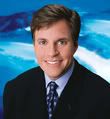
When we come back – we’ll talk to Milo of Kroton who will be going for an unprecedented sixth Olympic wrestling championship.
“Milo, you won here first in 540 BCE as a boy. It’s 24 years later and you’re going for a sixth championship. What are your thoughts on your opponents?”
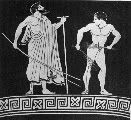
“Well, Bob, I never worry about my opponent. My goal is to force my style on him.”
“It’s been said that you are the strongest of all wrestlers. What is your workout routine?”
“This rock weighs 326 pounds. I’ll curl it several times and then bench it a couple dozen more.”
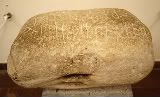
“Wow, I can’t even budge that.”
“I understand that the past couple of years have been pretty eventful for you.”
“Well, first there was the attack on our town. A neighboring city attacked and I put on my Olympic crowns, dressed like Herakles and led my fellow citizens to victory.”
“Then last year there was the incident at Pythagorean Hall. The roof started to collapse and I held the center column until everyone else in the hall escaped. Then, thanks to the great god Zeus, I was able to escape before the roof completely collapsed.”
“Amazing. Milo, good luck in the finals.”
“Thanks, Bob.”
“When we come back – an interview with Michael Phelps’ kindergarten teacher.”
What if NBC had covered the ancient games?

When we come back – we’ll talk to Milo of Kroton who will be going for an unprecedented sixth Olympic wrestling championship.
“Milo, you won here first in 540 BCE as a boy. It’s 24 years later and you’re going for a sixth championship. What are your thoughts on your opponents?”

“Well, Bob, I never worry about my opponent. My goal is to force my style on him.”
“It’s been said that you are the strongest of all wrestlers. What is your workout routine?”
“This rock weighs 326 pounds. I’ll curl it several times and then bench it a couple dozen more.”

“Wow, I can’t even budge that.”
“I understand that the past couple of years have been pretty eventful for you.”
“Well, first there was the attack on our town. A neighboring city attacked and I put on my Olympic crowns, dressed like Herakles and led my fellow citizens to victory.”
“Then last year there was the incident at Pythagorean Hall. The roof started to collapse and I held the center column until everyone else in the hall escaped. Then, thanks to the great god Zeus, I was able to escape before the roof completely collapsed.”
“Amazing. Milo, good luck in the finals.”
“Thanks, Bob.”
“When we come back – an interview with Michael Phelps’ kindergarten teacher.”
Monday, August 4, 2008
Olympic Boom
USA Gymnastics is helping its’ member gyms prepare for what they call the “Olympic Boom”. Every four years, after watching hours of prime time coverage of Olympic gymnastics, parents flock to gymnastics clubs around the nation to enroll their kids. Many are hoping that their little girl will be the next Mary Lou Retton, Kerry Strug or Shawn Johnson.
They published a comprehensive marketing plan called The Olympic Opportunity. As a marketing professional, I can tell you that it is fairly well done.
Wrestling will not experience the same boom. This is true, in part, because, unlike women’s gymnastics where every minute of competition by an American athlete will be covered in prime time by NBC, it is likely that only Americans wrestling in medal matches will make it to a coveted time slot. Pre-conceived parental perceptions of wrestling may also be a problem.
I searched the internet to see what USA Wrestling or the National Wrestling Coaches Association might be doing to use the Olympics as a participation growth tool. I found nothing related specific to the Olympics. However, the NWCA has several solid tools on its’ Program Entrenchment page. One of these is a recruiting presentation called The Participation Pyramid. It, too, is a marketing plan of sorts. However, if you compare it to USA Gymnastics’, The Olympic Opportunity, you’ll see that USA Gymnastics focuses on marketing to parents, while the Participation Pyramid is aimed at marketing to potential youth participants.
Will marketing to kids, without approaching parents, successfully increase wrestling participation? I doubt it. USA Wrestling helps its’ member associations reach out to parents with The Parent's Guide to Youth Wrestling. It is well written and addresses most of the misconceptions parents have about wrestling.
Now – I have a question. Please answer honestly. Did you read all the way through The Participation Pyramid or The Parent’s Guide to Youth Wrestling? I didn’t think so. Long, rational, tomes – while well intentioned – are rarely effective marketing tools. You need emotion. You need imagery. Kids need to see the potential excitement of wrestling. Parents need to see other parents enjoying the sport.
So – when the wrestlers are home from Beijing and back in their wrestling rooms or at their coaching jobs do we let the Olympics fade away into memory? I hope not. Our Olympians are from all corners of the country. Medal or not, personal appearances at elementary, middle and high schools will have a lasting impression. This past March I watched as about two dozen kids stood in the lobby of the Cedar Rapids US Cellular Center as Olympic gold medallist, Ben Peterson, passed around his “hardware”. To say they were rapt is an understatement.
In December the Iowa State Cyclones will come to Carver Hawkeye Arena for the annual battle with the Hawkeyes. There are likely to be at least 14,000 fans attending – many of who will be attending their first college wrestling meet. Yes, the meet will provide plenty of excitement. But – why not make it an even bigger event? At the very least there are likely to be four Olympic gold medallists in the building, anyway. Why not invite every living gold medallist from Iowa and ISU to be introduced during the halftime break?
You could do something similar at Gallagher-Iba Arena.
If you love the sport of wrestling – you don’t have the luxury of being a passive fan. We all need you to be an active supporter.
Here’s your first assignment. Invite one non-wrestling friend over to your house (preferably one with kids) and watch Olympic wrestling together. Be the expert commentator. Show enthusiasm. Get us a new fan – and maybe a new wrestler.
They published a comprehensive marketing plan called The Olympic Opportunity. As a marketing professional, I can tell you that it is fairly well done.
Wrestling will not experience the same boom. This is true, in part, because, unlike women’s gymnastics where every minute of competition by an American athlete will be covered in prime time by NBC, it is likely that only Americans wrestling in medal matches will make it to a coveted time slot. Pre-conceived parental perceptions of wrestling may also be a problem.
I searched the internet to see what USA Wrestling or the National Wrestling Coaches Association might be doing to use the Olympics as a participation growth tool. I found nothing related specific to the Olympics. However, the NWCA has several solid tools on its’ Program Entrenchment page. One of these is a recruiting presentation called The Participation Pyramid. It, too, is a marketing plan of sorts. However, if you compare it to USA Gymnastics’, The Olympic Opportunity, you’ll see that USA Gymnastics focuses on marketing to parents, while the Participation Pyramid is aimed at marketing to potential youth participants.
Will marketing to kids, without approaching parents, successfully increase wrestling participation? I doubt it. USA Wrestling helps its’ member associations reach out to parents with The Parent's Guide to Youth Wrestling. It is well written and addresses most of the misconceptions parents have about wrestling.
Now – I have a question. Please answer honestly. Did you read all the way through The Participation Pyramid or The Parent’s Guide to Youth Wrestling? I didn’t think so. Long, rational, tomes – while well intentioned – are rarely effective marketing tools. You need emotion. You need imagery. Kids need to see the potential excitement of wrestling. Parents need to see other parents enjoying the sport.
So – when the wrestlers are home from Beijing and back in their wrestling rooms or at their coaching jobs do we let the Olympics fade away into memory? I hope not. Our Olympians are from all corners of the country. Medal or not, personal appearances at elementary, middle and high schools will have a lasting impression. This past March I watched as about two dozen kids stood in the lobby of the Cedar Rapids US Cellular Center as Olympic gold medallist, Ben Peterson, passed around his “hardware”. To say they were rapt is an understatement.
In December the Iowa State Cyclones will come to Carver Hawkeye Arena for the annual battle with the Hawkeyes. There are likely to be at least 14,000 fans attending – many of who will be attending their first college wrestling meet. Yes, the meet will provide plenty of excitement. But – why not make it an even bigger event? At the very least there are likely to be four Olympic gold medallists in the building, anyway. Why not invite every living gold medallist from Iowa and ISU to be introduced during the halftime break?
You could do something similar at Gallagher-Iba Arena.
If you love the sport of wrestling – you don’t have the luxury of being a passive fan. We all need you to be an active supporter.
Here’s your first assignment. Invite one non-wrestling friend over to your house (preferably one with kids) and watch Olympic wrestling together. Be the expert commentator. Show enthusiasm. Get us a new fan – and maybe a new wrestler.
Subscribe to:
Posts (Atom)


